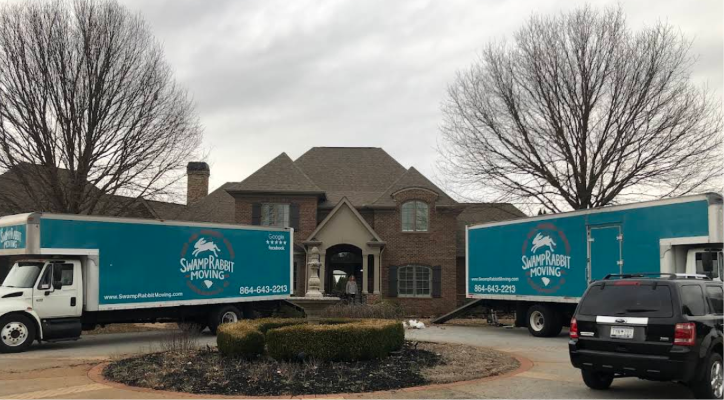
A crew can be on time, fully staffed, and ready to work, and still lose two hours sitting at a gate because nobody told the guard they were coming. It happens more often than people think, and it is almost always preventable with one phone call made a week earlier.
Many Simpsonville communities run active associations with rules about trucks, hours, parking, and insurance paperwork. Those rules are rarely difficult. They are just unwritten as far as most residents are concerned until the day they matter. Our residential local moving crews work these neighborhoods constantly, so here is what to check and when to check it.
Why Simpsonville HOAs Get Involved in Moving Day
Associations are not trying to make your life difficult. They are managing shared infrastructure, and a loaded moving truck is one of the heaviest things that will ever use a residential street. Newly poured driveways crack. Low-hanging limbs get torn down. Irrigation lines run shallow under grass verges that look perfectly solid.
The result is a layer of rules most residents never encounter until they move out or move in. Some communities require advance notice. Some restrict the hours trucks may operate. A few ask for proof of insurance before anything comes through the gate. None of it is unreasonable, but all of it takes time to arrange, and the arranging has to happen before moving day rather than on it. If you are still getting oriented, the practical side of settling into your new neighborhood covers a good deal of what comes after the truck leaves.
What to Confirm With Your HOA Before Booking
Call the management company rather than relying on the welcome packet. Packets go out of date, boards change rules, and the person answering the phone will tell you what is enforced right now. Make the call before you lock your moving date, not after, because a few of these restrictions can rule out entire days of the week.
Ask about all of the following and write the answers down:
- Whether advance written notice is required, and how many days
- Permitted hours for moving trucks, including weekend restrictions
- Any weight or length limit on vehicles entering the community
- Gate codes, call box procedure, or whether a guard needs a name list
- Whether a certificate of insurance is required from your mover
- Designated parking or staging areas for large vehicles
- Any deposit held against damage to common property
- Elevator reservation rules if you are in a building with one
Send the answers to your moving company as soon as you have them. A crew that knows the gate code, the parking spot, and the cutoff time can plan the load around all three. A crew that finds out at 8 am cannot.
Booking a move in a gated or managed community? Tell us the restrictions when you call, and we will build them into the plan. Reach us at (864) 643-2213 for a free written estimate.
Certificates of Insurance and Why Associations Ask for Them
A certificate of insurance is a one-page document from the mover's insurer naming the association as a certificate holder. It confirms coverage exists and states the limits. Associations ask for it because damage to a shared lobby, elevator, or entry gate becomes their problem to chase otherwise.
The request is routine, and any properly insured company can produce one. What catches people out is the lead time. Certificates come from the insurer rather than the moving company itself, and they are usually issued within a couple of business days rather than the same afternoon. Ask for it at least a week out. We are fully bonded and insured, and we issue these regularly for communities and buildings around the Upstate, so the only thing that slows the process down is a late request.
Gated Entries, Narrow Streets and Truck Access
Access is where theory meets physics. A 26-foot truck needs room to enter, room to turn, and room to sit while it loads, and plenty of attractive residential streets were never designed with that in mind. Cul-de-sacs with tight radii, streets lined with parked cars, low tree canopy, and narrow gate openings all count.
Walk the route yourself before the estimate. Stand where the truck will park and measure the distance to your front door, because anything past a hundred feet is a long carry and it changes the labor involved. If a full-size truck genuinely cannot reach the property, the answer is usually a shuttle, where a smaller vehicle ferries loads out to the larger one.
That is a legitimate and common arrangement, and it belongs in the written quote from the beginning rather than appearing as a surprise. Driveway width, canopy height, and gate clearance all belong on the same list as home features that complicate truck access. Tell the estimator about the gate, the turn, and the trees, and the number you receive will hold.
Timing Rules That Can Cost You a Day
Hour restrictions are the rule people most often forget, and they are the ones most likely to ruin a schedule. Communities commonly limit truck activity to weekday business hours, or ban it entirely on Sundays and holidays. Buildings with elevators often allocate the service elevator in blocks that have to be reserved weeks ahead.
Work the restriction into the plan rather than against it. If trucks have to be out by 6 pm, the load needs to start early enough to finish comfortably, which may mean packing the day before rather than the morning of. If the elevator is yours from 9 am to 1 pm only, everything heavy moves in that window and the rest follows after.
Our crews schedule around these constraints all the time, including evening and weekend commercial work where a building demands it. Getting the sequence right is most of the battle, and the practical steps to coordinate crew arrival and access will help you build a plan that survives contact with a real timetable.
Know your community rules and want a crew that works within them? Call (864) 643-2213 or contact us, and we will put a free, itemized estimate in writing for your Simpsonville move.
Related Topics: